Service
Land Leveling & Erosion Control
Uneven ground and moving soil are the same problem viewed from two angles. Leveling gives you usable space; erosion control keeps it that way.
Overview
Land leveling reshapes a property so the ground works for you — a flat area for a building, a gentler slope for a yard, a consistent fall that carries rain to where it should go.
Erosion control is the other half of the job. Bare, steep, or channeled soil moves every time it rains hard. Once a path forms, it deepens fast, and washed soil ends up in a driveway, a ditch, or a neighbor's yard.
Correcting the shape of the ground is usually the most durable fix. Softening a slope, breaking up a long uninterrupted run of water, and directing runoff to a stable outlet removes the force that was doing the damage.
Common Reasons Property Owners Need This Service
Washouts and gullies
Channels cutting across a yard, pasture or driveway edge mean water has found a path and is taking soil with it.
Slopes too steep to use or mow
Reshaping a bank can turn wasted ground into space you can actually walk, mow, or build on.
Soil piling against a structure
Runoff moving material toward a foundation, shed or retaining wall needs the grade changed upstream.
Ground left rough after clearing
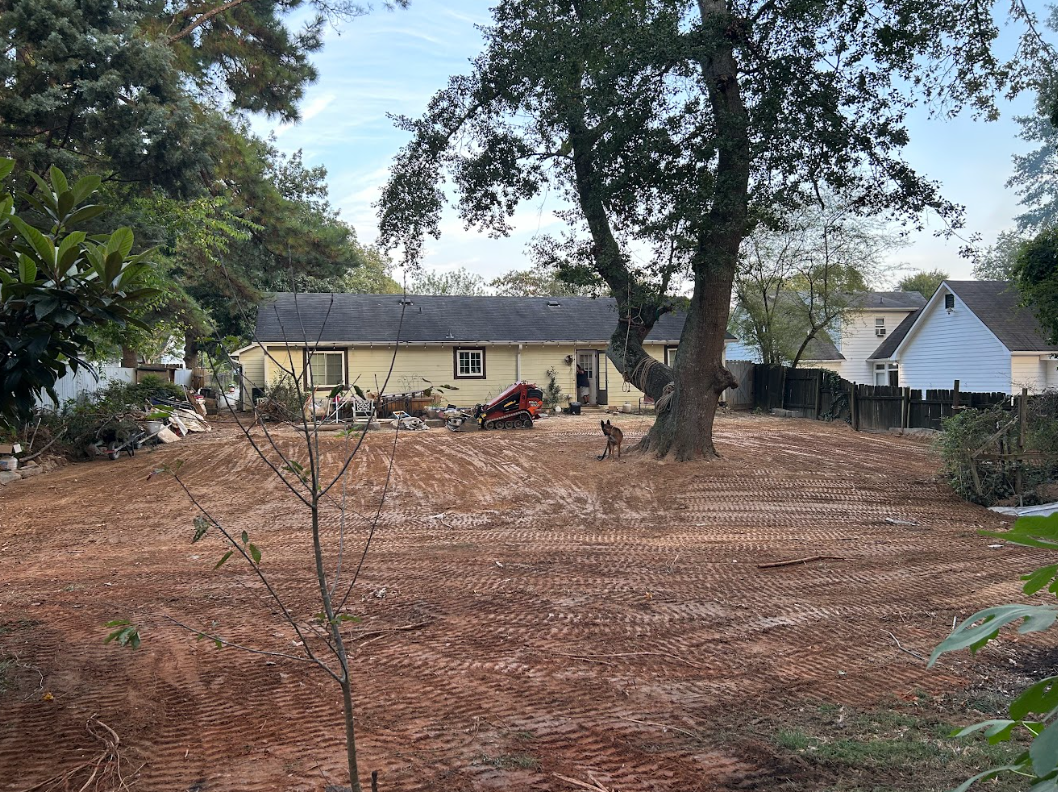
Freshly cleared land often needs leveling and stabilizing before it will hold vegetation.
Bare areas that will not grow
Soil that keeps washing away never holds seed. Shape it first, then stabilize it.
What a Project May Involve
- 1Look at where water enters the property, where it travels, and where it leaves.
- 2Set target elevations for the areas that need to be level or re-sloped.
- 3Cut and fill with a machine sized to the site, keeping haul distances short where possible.
- 4Shape swales, shoulders, or transitions that move water at a manageable speed.
- 5Leave surfaces ready for stabilization — seed, straw, matting, or stone as appropriate.
Residential Applications
- • Leveling back yards for play areas, above-ground pools, or sheds
- • Repairing washed-out banks along driveways and property lines
- • Softening slopes so a lawn can be mowed safely
- • Shaping ground after removing trees or outbuildings
Small Commercial Applications
- • Leveling small equipment and storage areas
- • Stabilizing slopes and shoulders around small commercial sites
- • Reshaping ground where runoff has undercut a drive or pad
Questions
Land Leveling & Erosion Control — Questions
- What causes erosion in a Georgia yard?
- Usually bare soil combined with a slope and concentrated water. Roof runoff, driveway edges, and long uninterrupted slopes all speed it up.
- Can a slope be leveled without a retaining wall?
- Often, yes. If there is room to lay the slope back at a gentler angle, reshaping the ground avoids the cost of a wall. Tight spaces are where walls make sense.
- Will grading stop soil from washing onto my driveway?
- Intercepting and redirecting the water before it reaches the driveway is usually what solves it, along with stabilizing the source area.
- How soon should bare graded ground be seeded?
- As soon as practical. Bare soil is at its most vulnerable, so getting cover established quickly protects the work.
- Do you install silt fence or erosion matting?
- Stabilization measures are quoted based on what the site needs. Talk through the project and we will tell you what applies.
- Can leveling create a flat pad for a shop or barn?
- Yes, and that overlaps with pad preparation. Larger structures usually need compaction and a stone base as well.
Planning a Grading or Clearing Project?
Call Hugo Grading & Clearing at (470) 430-8701 or request an estimate online.