Service
Forestry Mulching
A mulching head cuts the growth and leaves it on the ground as mulch. One machine, one pass, no debris pile to deal with afterward.
On the job
forestry mulching in Action
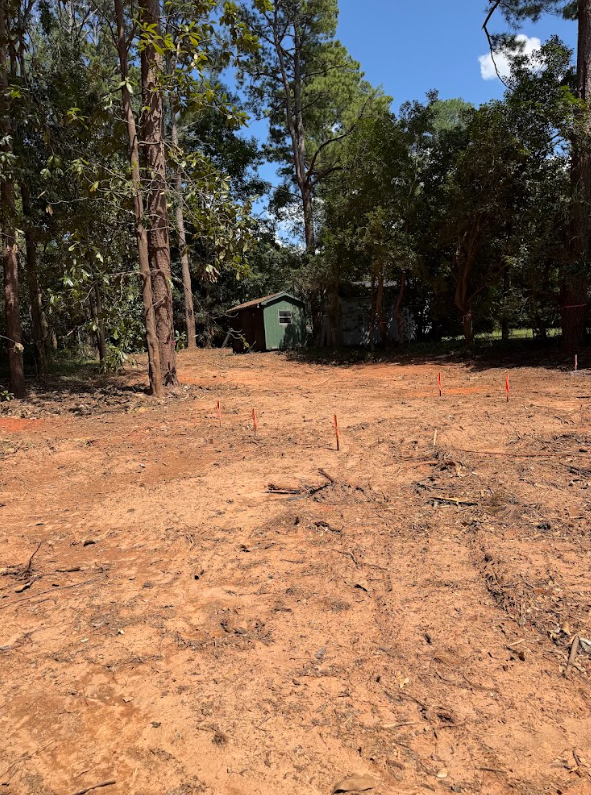
Forestry mulching in progress on a wooded residential lot
Overview
Forestry mulching uses a cutting head mounted on a compact track loader to grind standing vegetation where it stands. Brush, briars, vines and small trees go through the head and come out as a coarse mulch spread across the ground.
Because nothing has to be dragged, stacked, burned or hauled, mulching is often the most efficient way to open up a wooded or overgrown area. The mulch layer also holds soil in place and breaks down over time.
It is selective work. Mature trees you want to keep stay standing while the understory around them is cleared, which is why mulching suits properties where the goal is to open up ground rather than strip it.
Common Reasons Property Owners Need This Service
Overgrown acreage
Land that has not been maintained for years becomes impassable. Mulching makes it walkable and visible again.
Property lines and fence rows
Clearing a strip along a boundary makes fencing, surveying and maintenance possible.
Trails, access lanes and food plots
Cutting a path through the understory opens access without building a road.
Wildfire and pest reduction
Reducing dense fuel and thick undergrowth close to structures lowers risk and cuts down on habitat for pests.
Pre-development site opening
Mulching reveals the terrain so grading, surveying and layout can be planned accurately.
What a Project May Involve
- 1Walk the area and agree on what gets cut and what stays.
- 2Flag trees, lines, wells, or features that must be protected.
- 3Mulch in passes, working around retained trees and obstacles.
- 4Spread the mulch layer to a reasonably even depth.
- 5Review the finished area and discuss whether grading or seeding should follow.
Residential Applications
- • Reclaiming overgrown back sections of residential lots
- • Clearing understory around a home for visibility and access
- • Opening space for a shed, garden, pen or play area
- • Clearing along fence lines and driveways
Small Commercial Applications
- • Opening small commercial parcels for survey and layout
- • Maintaining vegetation along access drives and easements
- • Clearing overgrowth around storage yards and outbuildings
Questions
Forestry Mulching — Questions
- What is forestry mulching used for?
- Clearing brush, briars, vines and small trees while leaving the material on site as mulch. It is common on overgrown lots, property lines, and land being opened up for use.
- What is the difference between brush cutting and forestry mulching?
- Brush cutting knocks growth down; mulching grinds it into a mulch layer. Mulching leaves a more finished surface and handles thicker material.
- Does mulching remove stumps?
- Mulching cuts material at or near ground level and can grind low stumps down, but it is not stump removal. Full stump extraction is excavation work.
- How thick is the mulch layer left behind?
- It depends on how much vegetation was standing. Heavier growth leaves a deeper layer, which thins out over the following seasons.
- Can you mulch around trees I want to keep?
- Yes. Mark the trees you want left and the machine works around them.
- Can grass grow after mulching?
- Once the mulch layer thins and light reaches the ground, yes. On areas you want planted sooner, grading or raking the mulch helps.
- How large a tree can be mulched?
- Smaller trees and saplings go through the head. Larger trunks are better handled as tree work or removal, and we will tell you where the line is on your property.
Planning a Grading or Clearing Project?
Call Hugo Grading & Clearing at (470) 430-8701 or request an estimate online.